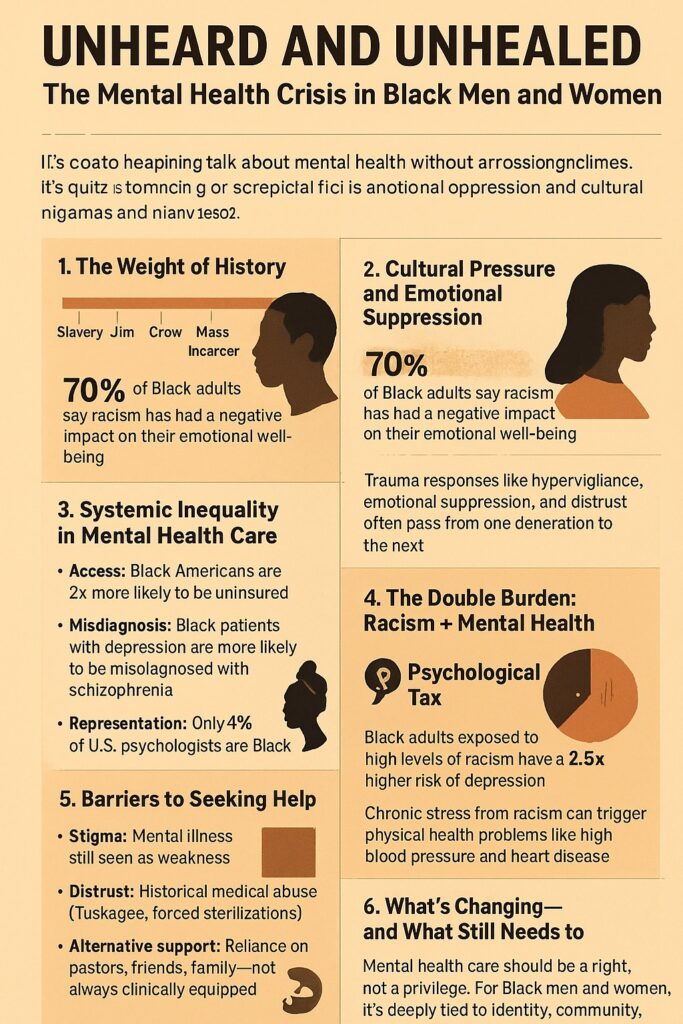
Why We Need to Talk About This—Now
Over the past decade, the world has started paying more attention to mental health.
It’s easy to recognize a broken bone or a fever—you can see it, measure it, treat it.
But mental health? The symptoms can be silent, invisible, and easily dismissed.
For Black communities, especially men and women, there’s an extra layer of difficulty: systemic oppression, cultural stigmas, and historical trauma that make it harder to name pain, let alone treat it.
📊 Quick Fact: Black Americans are 20% more likely to experience serious mental health problems than the general population—but are less likely to receive treatment.
Mental health doesn’t discriminate. Access to care, social acceptance, and cultural narratives do. And right now, they’re stacked against us.
The Weight of History
You can’t talk about Black mental health without talking about Black history. From slavery and segregation to redlining and mass incarceration, Black life in America has been shaped by chronic adversity.
This isn’t just history—it’s inherited trauma.
🖤 Key Statistic:
-
70% of Black adults say racism has had a negative impact on their emotional well-being.
-
Trauma responses like hypervigilance, emotional suppression, and distrust often pass from one generation to the next.
🖼 Infographic Idea:
A timeline showing key historical events (slavery → Jim Crow → redlining → present-day mass incarceration) with mental health impacts listed below.
Cultural Pressure and Emotional Suppression
For Black men, “strength” is often defined by silence. Vulnerability is painted as weakness. You hear it young: Man up. Don’t cry. Handle it. That’s emotional armor—but it’s heavy.
For Black women, the cultural script says: be strong, be unshakable, carry everyone else.
The “Strong Black Woman” trope sounds empowering but leaves no space for burnout, breakdowns, or rest.
📊 Stat to Know: Black women are more likely than white women to report feelings of sadness, hopelessness, and worthlessness—but less likely to receive mental health treatment.
🖼 Infographic Idea:
Two silhouettes (man + woman) with words like Stoicism, Strength, Silence, Caregiver written on their bodies, contrasted with what’s hidden inside: Anxiety, Depression, Burnout, Grief.
Systemic Inequality in Mental Health Care
Even when Black individuals seek help, the system isn’t built for them.
-
Access: Black Americans are 2x more likely to be uninsured.
-
Misdiagnosis: Black patients with depression are more likely to be misdiagnosed with schizophrenia.
-
Representation: Only 4% of U.S. psychologists are Black.
🖼 Infographic Idea:
A pie chart showing the racial breakdown of psychologists in the U.S., highlighting the small slice that is Black.
This lack of representation and cultural understanding means therapy often doesn’t feel safe—or even worth returning to.
The Double Burden: Racism + Mental Health
Racism is more than a social problem—it’s a psychological tax.
Everyday racism—microaggressions, workplace bias, racial profiling—creates constant mental strain.
📊 Impact:
-
Black adults exposed to high levels of racism have a 2.5x higher risk of depression.
-
Chronic stress from racism can trigger physical health problems like high blood pressure and heart disease.
🖼 Infographic Idea:
“Psychological Tax” graphic showing how racism drains mental, emotional, and physical energy over time.
Barriers to Seeking Help
Why aren’t more Black men and women in therapy?
-
Stigma: Mental illness still seen as weakness.
-
Distrust: Historical medical abuse (Tuskegee, forced sterilizations).
-
Alternative Support: Reliance on pastors, friends, family—valuable, but not always clinically equipped.
📊 Stat: Only 1 in 3 Black adults who need mental health care actually receive it.
🖼 Infographic Idea:
Side-by-side: “Needs Mental Health Care” vs. “Receives Care” bar graph.
What’s Changing—and What Still Needs to
There’s hope. Campaigns like Therapy for Black Girls and Black Men Heal are breaking barriers. Celebrities are speaking out. More young Black people are talking openly about mental health than any generation before them.
But visibility isn’t enough. We need:
-
Policy reform to expand services in Black communities.
-
Cultural competency training for clinicians.
-
Workplace protections for mental health.
-
A shift in culture where therapy is self-care, not crisis care.
Personal Stories: Faces Behind the Statistics
Jamal’s Journey: From Silence to Speaking
Jamal, 31, grew up believing that Black men don’t go to therapy. After his father’s sudden death, panic attacks began controlling his life. “I thought I was having heart attacks,” he recalls. “I went to the ER three times before someone suggested anxiety.”
Finding a Black male therapist changed everything. “He understood that my hypervigilance wasn’t paranoia—it was survival. He helped me separate past trauma from present reality.”
Today, Jamal advocates for men’s mental health in his community and has brought his teenage son to therapy preventively. “I want to break the cycle. My son will know it’s okay to feel.”
Dr. Aisha’s Mission: Healing from Within
Dr. Aisha Williams became a psychologist after experiencing racism in her own therapy. “My white therapist kept attributing my stress to ‘cultural factors’ rather than understanding that racism was literally making me sick.”
Now she runs a practice specializing in racial trauma. “Black people don’t need to be fixed,” she explains. “We need healing from systems that were designed to break us. That’s very different work.”
Her practice incorporates African healing traditions, mindfulness practices, and social justice awareness into traditional therapy approaches.
The Johnson Family: Generational Healing
When 16-year-old Malik Johnson attempted suicide, his family faced a choice: continue the silence or break generational patterns.
“We almost lost our son because we didn’t know the signs,” says his mother, Patricia. “In our family, you didn’t talk about feelings. You worked through problems.”
The family entered therapy together, uncovering patterns of untreated depression spanning three generations. “Therapy saved our family,” Patricia reflects. “We learned that getting help isn’t giving up—it’s growing up.”
Conclusion: Our Collective Healing Journey
Mental health care should be a right, not a privilege. For Black men and women, it’s deeply tied to identity, community, survival, and ultimately, liberation.
We’ve carried the weight of silence for too long. We’ve accepted systems that weren’t built for our healing. We’ve internalized messages that our pain doesn’t matter as much, that our strength means we don’t need support, that asking for help is a sign of weakness rather than wisdom.
But change is coming. It’s in the young Black woman who refuses to carry her family’s emotional burdens alone. It’s in the Black man who chooses therapy over isolation. It’s in the parents who break generational cycles of silence. It’s in the communities that are creating new narratives around Black mental wellness.
The path to healing isn’t just individual—it’s collective. As we work to transform systems, change policies, and shift cultural narratives, we must also tend to our own mental gardens with the same care we give to everything and everyone else.
Your mental health matters. Your healing matters. Your voice in this conversation matters.
The silence has been broken. Now it’s time to speak, heal, and fight for a future where Black mental health is treated as the priority it’s always deserved to be.
If you or someone you know is struggling with mental health, you’re not alone. Resources, support, and hope are available. Seeking help isn’t giving up—it’s the bravest thing you can do.